

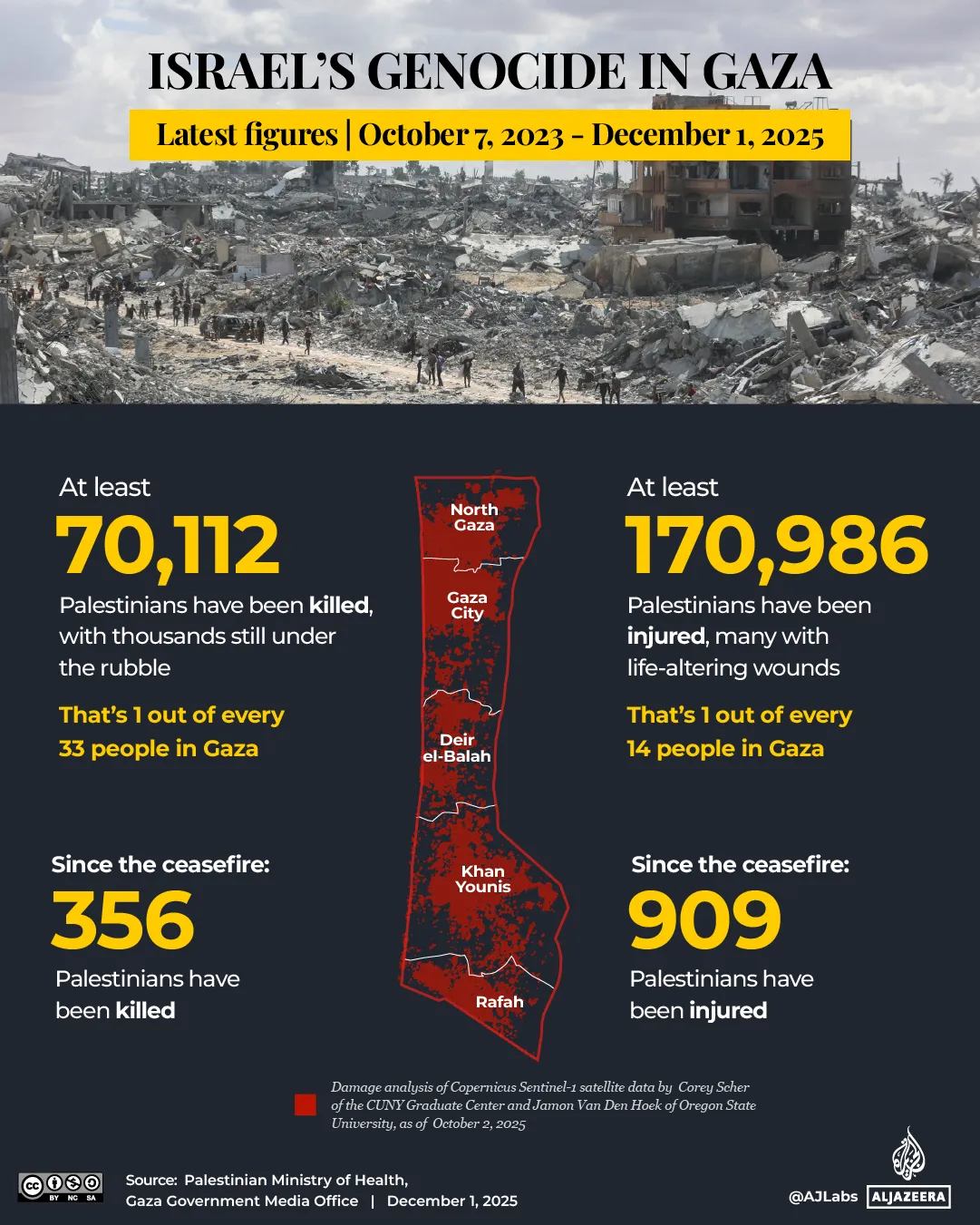
Since the ceasefire took effect, Israeli attacks have killed at least 356 Palestinians and injured 909.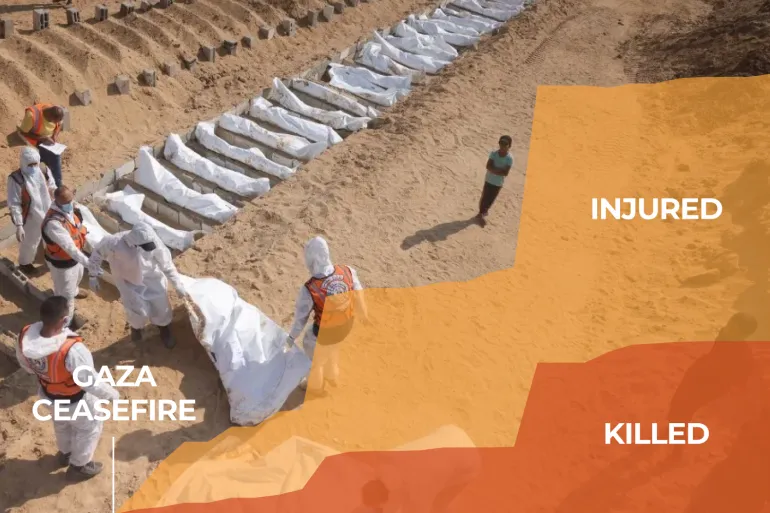

Since the declaration of a ceasefire in the Gaza Strip on October 10, 2025, Israel has violated the agreement with near-daily attacks, killing hundreds of people.
Israel violated the ceasefire agreement at least 591 times from October 10 to December 2, through the continuation of attacks by air, artillery and direct shootings, the Government Media Office in Gaza reports.
The office said Israel shot at civilians 164 times, raided residential areas beyond the “yellow line” 25 times, bombed and shelled Gaza 280 times, and demolished people’s properties on 118 occasions. It added that Israel had also detained 35 Palestinians from Gaza over the past month.
Israel has also continued to block vital humanitarian aid and destroy homes and infrastructure across the Strip.
Al Jazeera has tracked the ceasefire violations to date.
What are the terms of the ceasefire?
On September 29, the United States unveiled a 20-point proposal to end Israel’s genocidal war on Gaza, release the remaining captives held in the enclave, allow the full entry of humanitarian aid into the besieged territory and outline a three-phase withdrawal of Israeli forces.
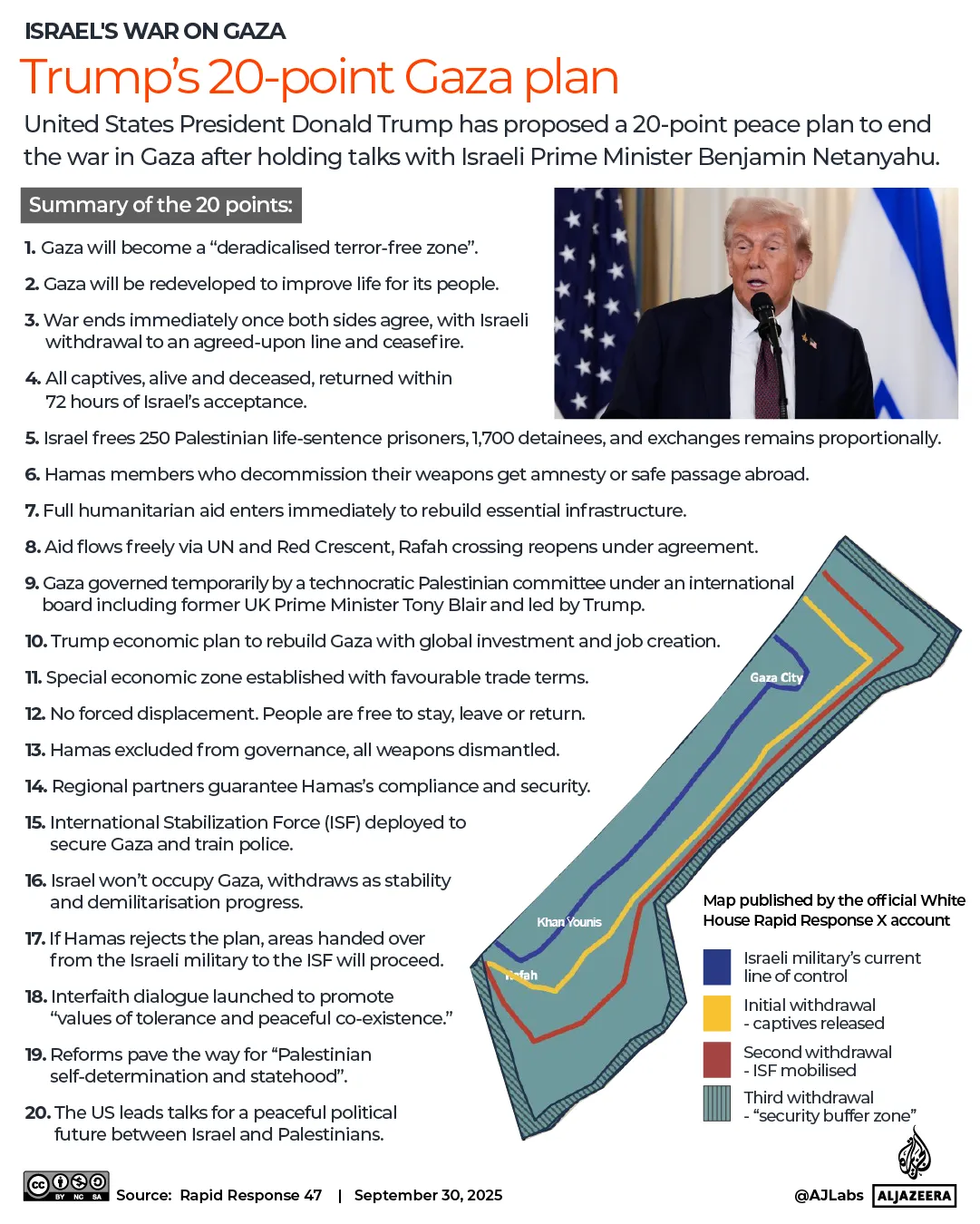

Some of the main conditions of the first phase, which is ongoing, include:
- An end to hostilities in Gaza between Israel and Hamas
- Lifting the blockade of all aid into Gaza by Israel and stopping its interference in aid distribution
- Release of all captives held in Gaza – alive or dead – by Hamas
- Release of some 2,000 Palestinian prisoners and disappeared people from Israeli jails
- Withdrawal of Israeli forces to the “yellow line”
- Following mediation by partners including Egypt, Qatar, and Turkiye, representatives from some 30 countries gathered on October 13 for a ceremony to sign the Gaza ceasefire agreement, led by US President Donald Trump.
However, Israel and Hamas were notably absent, raising doubts about the summit’s ability to achieve tangible progress towards ending the war and resolving the core issues of Israel’s occupation and the 18-year-long siege of Gaza.
Israel has pledged not to allow a Palestinian state, and the US has continued its large-scale arms transfers and diplomatic backing to Israel throughout its genocidal war on Gaza, while offering only vague statements about Gaza’s future.
Israel attacks Gaza nearly every day
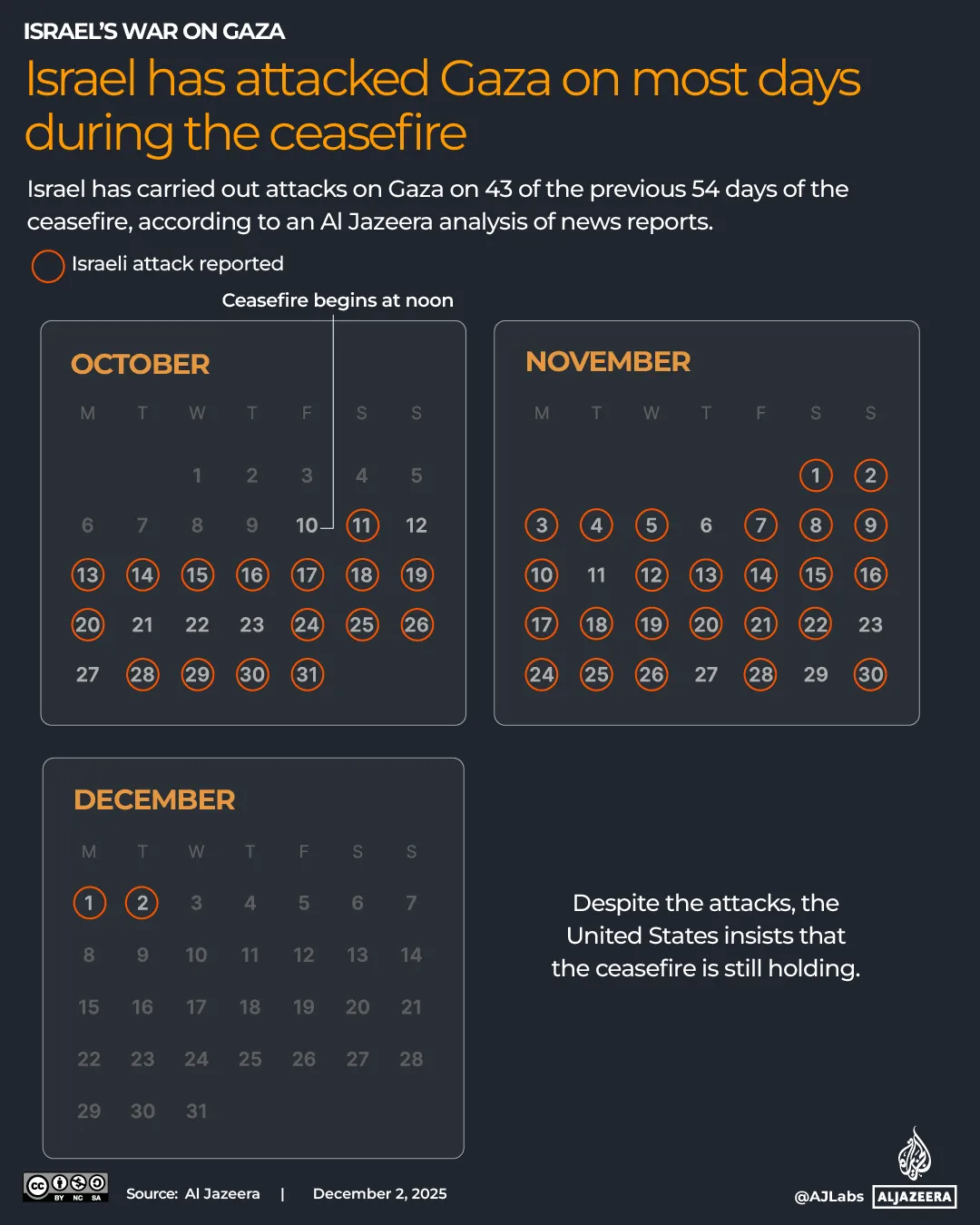
According to an analysis by Al Jazeera, Israel has attacked Gaza on 43 out of the past 54 days of the ceasefire, meaning there were only 11 days during which no violent attacks, deaths or injuries were reported.
Despite continuing attacks, the US insists that the “ceasefire” is still holding.

Israel still killing Palestinians
Since the ceasefire took effect at noon on October 10, Israel has killed at least 356 Palestinians and injured 909, according to the latest figures from the Palestinian Ministry of Health.
On October 19 and 29 – two of the deadliest days since the latest ceasefire – Israel killed a total of 154 people.
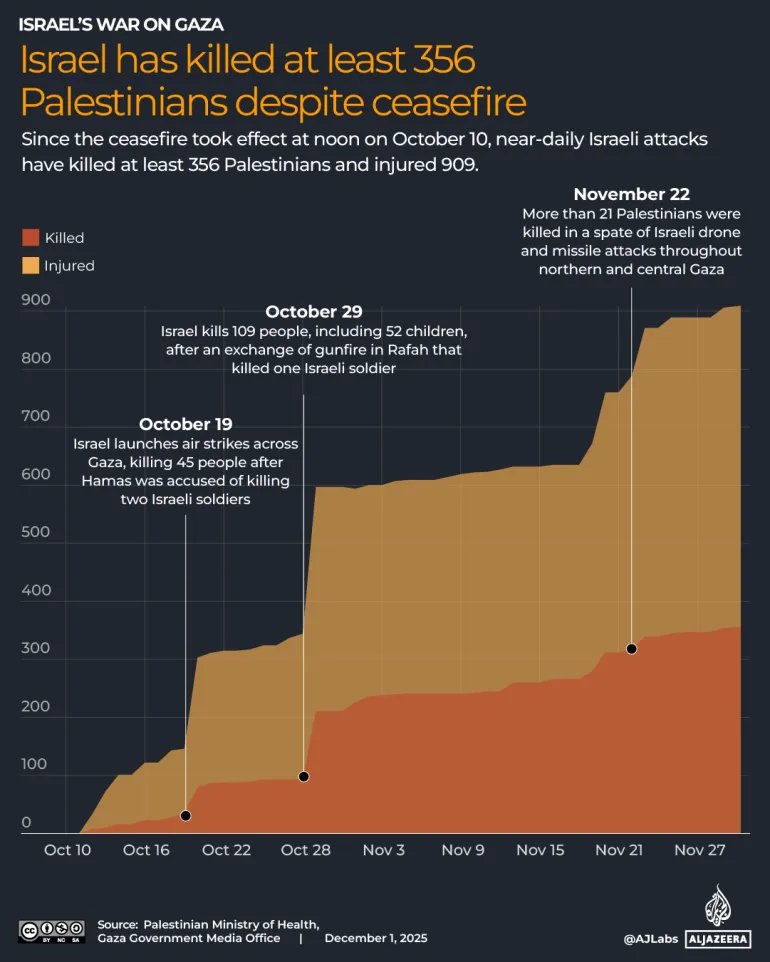

On October 19, accusing Hamas of violating the ceasefire after two Israeli soldiers were killed in Rafah, Israeli forces killed 45 people in a massive wave of air raids across the Gaza Strip.
Hamas’s armed wing, the Qassam Brigades, pointed out that Israel controls the Rafah area and it had no contact with any Palestinian fighters there.
On October 29, Israel killed 109 people, including 52 children, after an exchange of gunfire in Rafah that killed one Israeli soldier.
“The Israelis hit back, and they should hit back,” Trump told reporters, calling Israel’s attacks “retribution” for the soldier’s death.
On November 22, at least 21 Palestinians were killed in a spate of Israeli drone and missile attacks throughout northern and central Gaza, with dozens of others wounded.
Here are the latest figures from the Palestinian Ministry of Health in Gaza, tracking the casualties from October 7, 2023, through December 1, 2025:
- Confirmed killed: at least 70,112 people, including 20,179 children
- Injured: at least 170,986 people

Israel still choking aid
The ceasefire stipulated that “full aid will be immediately sent into the Gaza Strip”. However, the reality on the ground remains very different.
According to the World Food Programme (WFP), only half the required food aid is currently reaching Gaza, while a coalition of Palestinian relief agencies says total aid deliveries amount to just one-quarter of what was agreed under the ceasefire.
From October 10 to December 1, only 6,277 trucks have reached their intended destinations inside Gaza, according to the UN2720 Monitoring and Tracking Dashboard, which monitors humanitarian aid in Gaza.
According to truck drivers, aid deliveries are facing significant delays, with Israeli inspections taking much longer than expected.
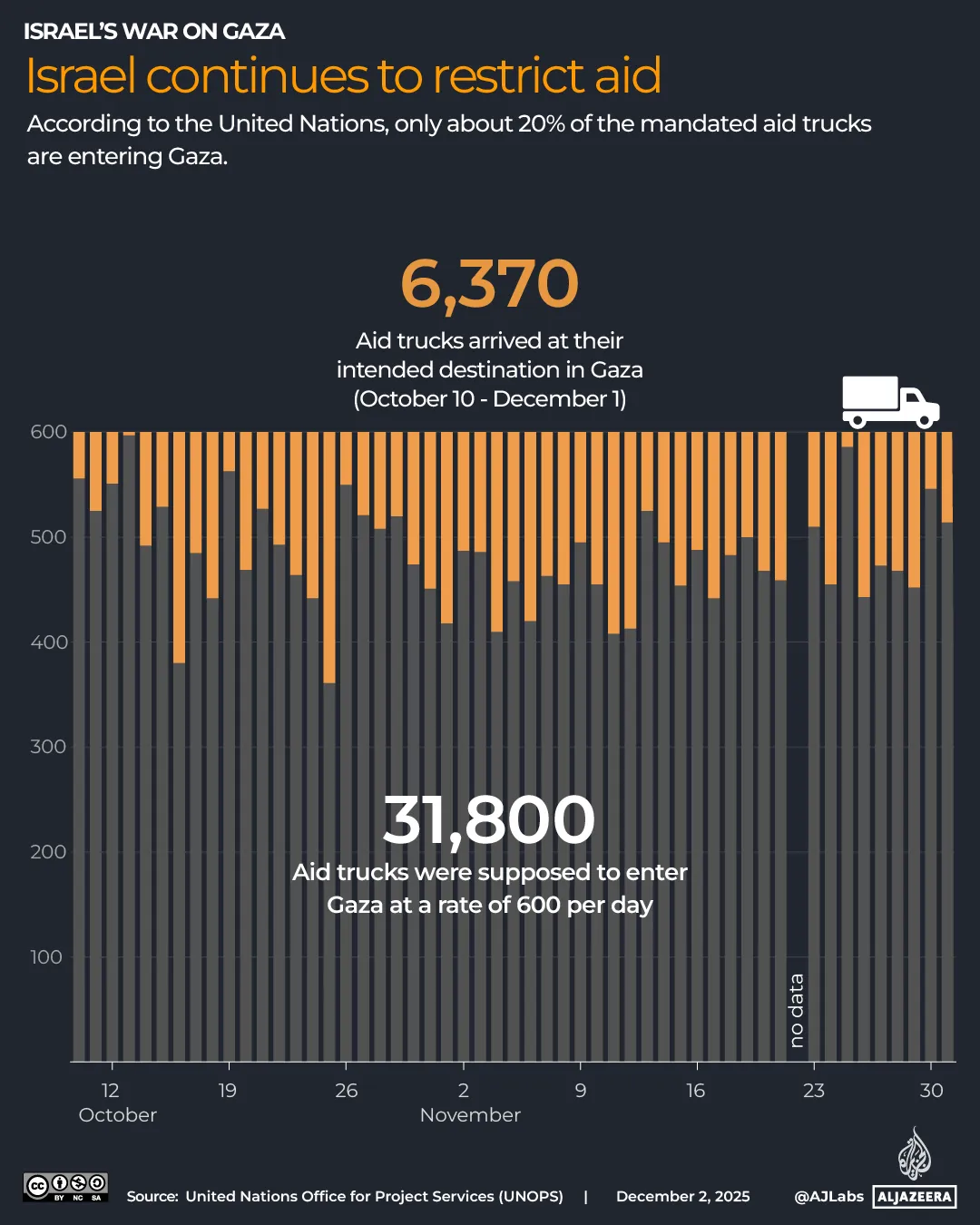
The White House said earlier that nearly 15,000 trucks carrying commercial goods and humanitarian aid entered Gaza between October 10 and November 9, a figure sharply disputed by Palestinians and aid groups.
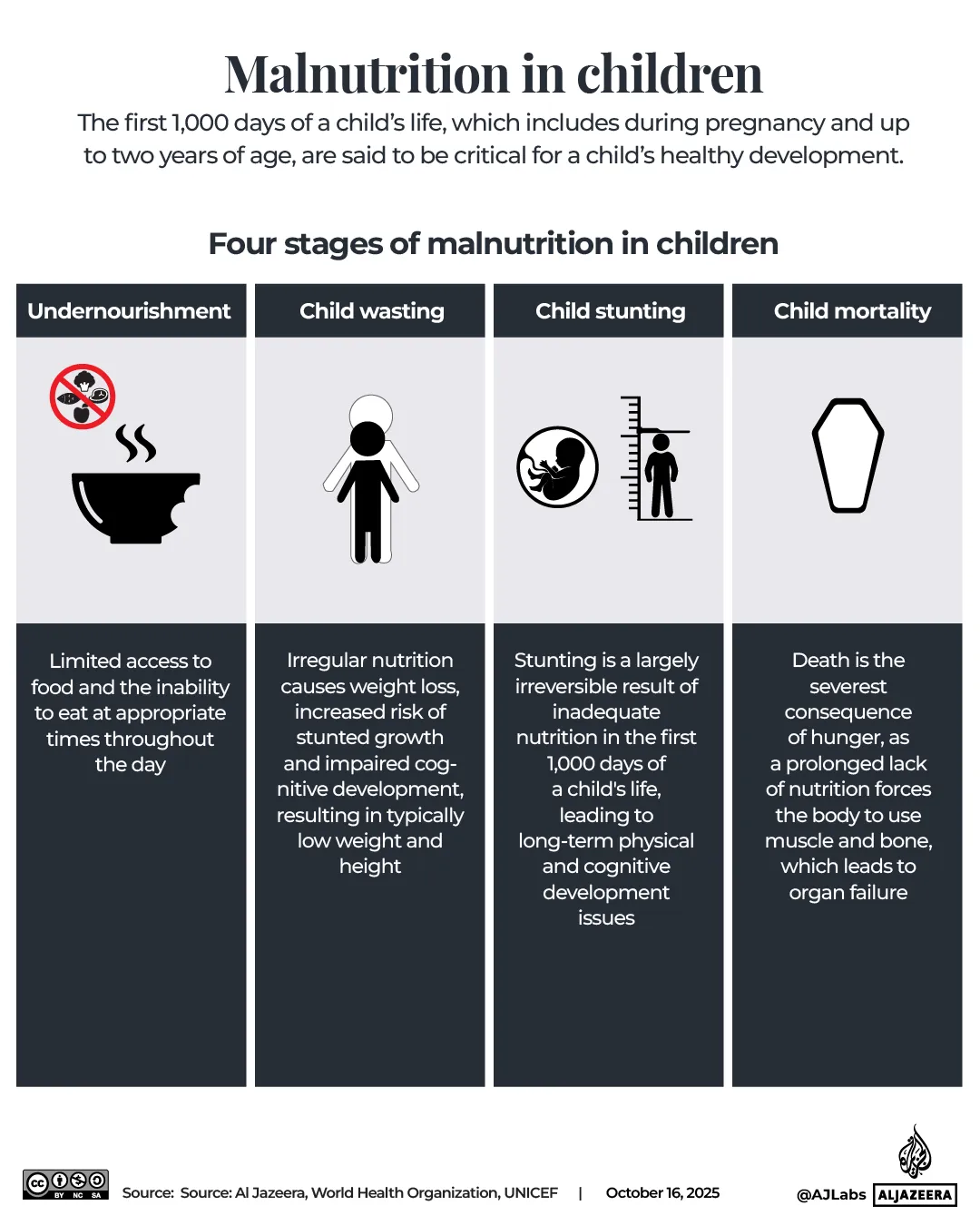
In addition, Israel has blocked essential and nutritious food items, including meat, dairy, and vegetables, crucial for a balanced diet. Instead, non-nutritious foodstuffs are being allowed, such as snacks, chocolate, crisps, and soft drinks.
Has Hamas released all of the captives?
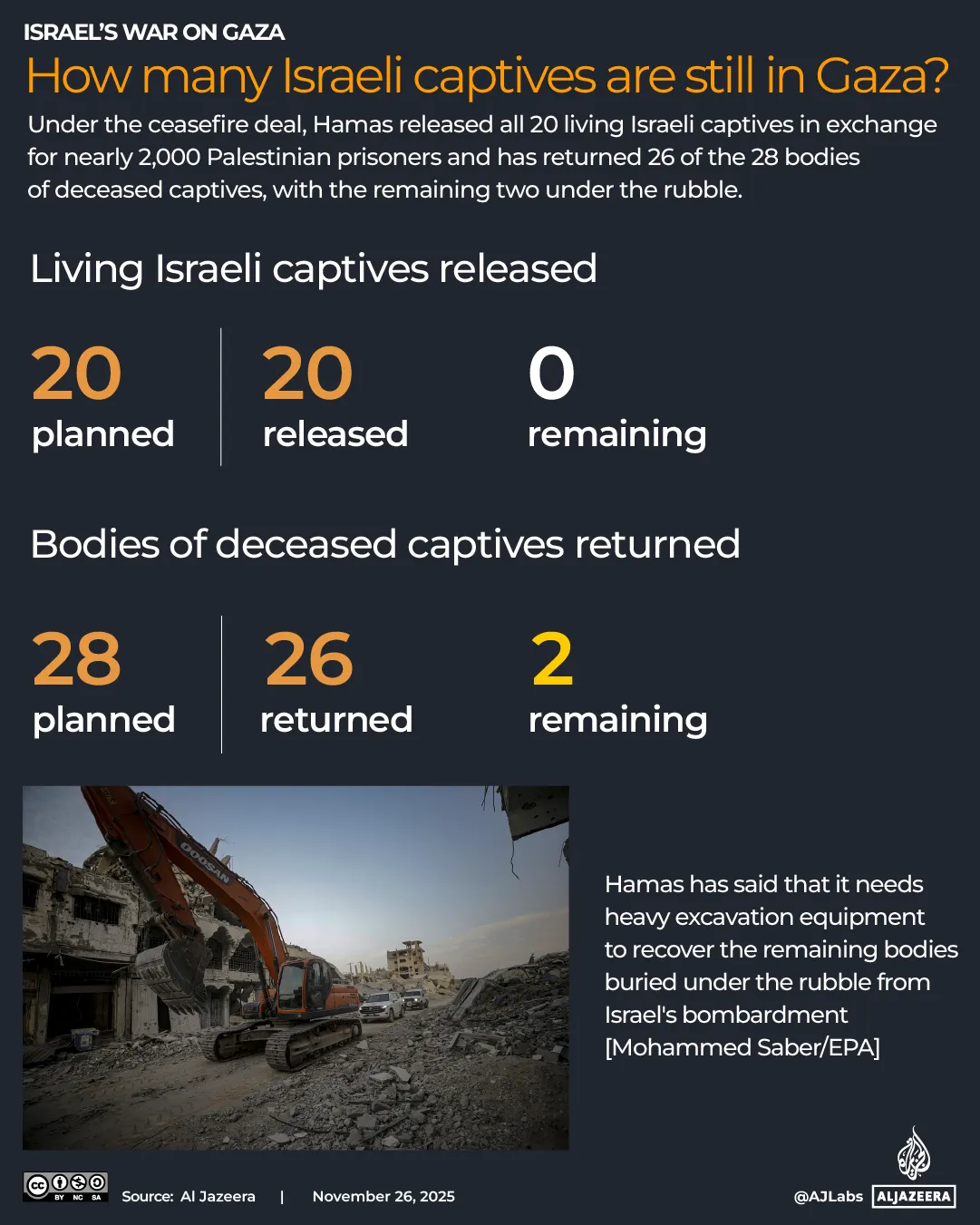
On October 13, as per the ceasefire deal, Hamas released all 20 remaining living Israeli captives in exchange for 250 Palestinians serving long prison sentences and 1,700 Palestinians disappeared by Israel since October 7, 2023.
As part of the deal, Hamas is also expected to return the bodies of 28 Israeli captives in exchange for 360 Palestinian bodies held by Israel.
As of November 26, Hamas had returned 26 Israeli captives’ bodies, with two remaining in Gaza. The group has said it requires heavy excavation equipment to recover the remaining bodies buried under the rubble from Israeli bombardment.
Israel has so far returned more than 300 Palestinian bodies, many of which were mutilated and showed signs of torture. Many remain unidentified.
What does international law say about ceasefires?
According to the Lieber Institute, a ceasefire is designed to halt active combat, or “freeze a conflict in place”, but it can be ambiguous in international law.
The suspension of hostilities is best understood as a cessation of active hostile military operations.
Resuming hostilities would breach political agreements, but it might not be a violation of international law unless the ceasefire was part of a binding treaty or United Nations Security Council resolution.