


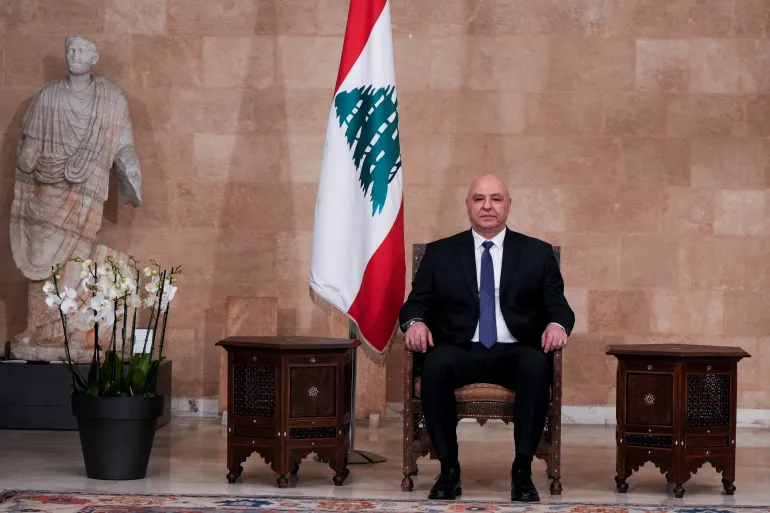
Lebanese president says latest ‘aggression’ represents an environmental crime and a violation of country’s sovereignty.
Lebanon’s President Joseph Aoun has accused Israel of committing an environmental crime after Israeli forces sprayed an unknown substance over southern Lebanese towns, which Beirut described as toxic.
Aoun condemned the Israeli move on Wednesday, saying he ordered government agencies to take all diplomatic and legal measures to “respond to this aggression”, which he said represents a “blatant violation” of Lebanon’s sovereignty.
“This is an environmental and health crime against Lebanese citizens and their land,” Aoun was quoted as saying by Lebanon’s National News Agency.
He added that the incident is a “continuation of repeated Israeli attacks on Lebanon and its people”.
Since Hezbollah and Israel reached a ceasefire agreement in November 2024, Israel has been attacking Lebanon almost daily in breach of the deal.
“These dangerous practices that target agricultural lands and the livelihoods of citizens and threaten their health and environment require the international community and relevant United Nations organisations to assume their responsibilities to stop these attacks,” Aoun said.
UN peacekeepers in south Lebanon, known as UNIFIL, had said they were informed on Monday by the Israeli military that it would spray a “non-toxic chemical substance” from the air over areas near the border.
“The [Israeli military] said that peacekeepers should stay away and remain under cover, forcing them to cancel over a dozen activities,” UNIFIL said.
Stephane Dujarric, spokesperson for UN Secretary-General Antonio Guterres, said on Tuesday that UNIFIL suspended its operations for nine hours due to the attack, and the force later worked with the Lebanese army to collect samples of the sprayed substance to be tested for toxicity.
The exact nature of the chemical remains unclear.
“Any activity that may put peacekeepers and civilians at risk is of serious concern,” Dujarric had said on Monday. “We reiterate our call on all parties to fully comply with their obligations under resolution 1701.”
UN Security Council Resolution 1701, which ended a war between Israel and Hezbollah in 2006, remains the basis of the ceasefire in south Lebanon.
Israel continues to occupy five points within Lebanese territory as it blocks the reconstruction of several border villages that it levelled to the ground, preventing tens of thousands of displaced people from returning to their homes.
The Lebanese government has been pushing to stem Israeli violations through diplomacy to no avail.
In January, Lebanon’s Ministry of Foreign Affairs submitted a complaint to the UN, documenting 2,036 Israeli breaches of the ceasefire in the final three months of 2025.
At the same time, last year, Beirut issued a decree to disarm Hezbollah, which the Iran-allied group has called a “grave” mistake.
The Lebanese party argues that its armed wing is necessary to stop Israel’s expansionism.
Still, Hezbollah, which has been weakened by the 2024 Israeli assault that killed the group’s top leaders, has not responded militarily to the repeated Israeli attacks.
While refusing to give up its weapons, Hezbollah has tacitly agreed to disarmament south of the Litani River by the Israeli border in accordance with UN Resolution 1701. Last month, the Lebanese government said it completed removing Hezbollah’s weapons in that area.
The second stage of Beirut’s disarmament plan will cover the region south of the Awali River, about 40km (25 miles) north of the Litani.