


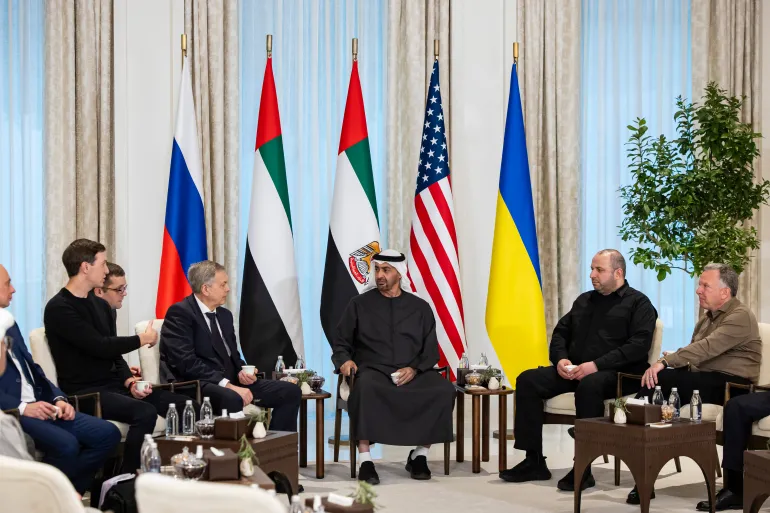
The main sticking point in the negotiations continues to be the long-term fate of territory in eastern Ukraine.
Ukrainian and Russian negotiators have begun a second round of United States-brokered talks in the United Arab Emirates (UAE) as they seek to advance the fraught negotiations on how to end Russia’s nearly four-year war on Ukraine.
The Russian and Ukrainian delegations arrived in Abu Dhabi on Wednesday morning, according to Russian state media and a spokesperson for the Ukrainian chief negotiator. It remained unclear when the US delegation would arrive.
“Another round of negotiations has begun in Abu Dhabi,” Rustem Umerov, head of the Ukrainian delegation, wrote on social media, adding Kyiv’s team was seeking “to achieve a just and lasting peace”.
The two-day trilateral talks in Abu Dhabi come as Ukrainian President Volodymyr Zelenskyy accused Russia of violating an agreement brokered by US President Donald Trump that called for ceasing attacks on energy facilities.
A large Russian drone and missile barrage in the run-up to the talks pounded Ukraine’s energy grid, knocked out power and heating in temperatures far below freezing and threatened to overshadow any chances of progress in the Emirati capital.
“Each such Russian strike confirms that attitudes in Moscow have not changed. They continue to bet on war and the destruction of Ukraine, and they do not take diplomacy seriously,” Zelenskyy said on Tuesday.
“The work of our negotiating team will be adjusted accordingly,” he said without elaborating.
“Many Ukrainians here are hoping that there will be another pause on [strikes targeting] energy infrastructure” after the second meeting in Abu Dhabi, Al Jazeera’s Audrey MacAlpine said, reporting from Kyiv.
However, given the “very little progress” that was achieved during the “first round of meetings, many here are not hopeful” that a deal will be struck with Russia, MacAlpine added.
The first round of meetings was held in the UAE last month, marking the first direct public negotiations between Moscow and Kyiv on a plan proposed by the Trump administration to end the conflict – Europe’s worst since World War II.
While the Trump administration over the past year has pushed the two sides to find compromises, breaking the deadlock on key issues appears no closer as the fourth anniversary of Russia’s invasion of its neighbour approaches this month.
What are the sticking points?
The main sticking point is the long-term fate of territory in eastern Ukraine, large parts of which Russia has occupied. Security guarantees for Ukraine against future Russian attacks have also been an obstacle.
Moscow is demanding that Kyiv pull its troops out of swaths of the Donbas, including heavily fortified cities that sit atop vast natural resources, as a condition of any deal. It also wants international recognition for the land it has unilaterally annexed in eastern Ukraine.
Kyiv said the conflict should be frozen along the current front lines and has rejected a one-sided pullback of forces.
While Ukraine’s delegation is headed by Umerov, the head of the National Security and Defence Council, Russia is represented by its military intelligence director, Igor Kostyukov, a career naval officer sanctioned in the West over his role in the Ukraine invasion.
Russian presidential envoy Kirill Dmitriev attended talks in Florida with US officials over the weekend. While neither side released details of what was discussed, US special envoy Steve Witkoff said they were “productive and constructive”.
Witkoff led the US team during last month’s talks.
Russia, which occupies about 20 percent of its neighbour, has threatened to take the rest of the Donetsk region in the Donbas if talks fail.
Ukraine has warned that ceding ground will embolden Moscow and it will not sign a deal that fails to deter Russia from invading again.
Kyiv still controls about one-fifth of the mineral-rich Donetsk region.
Russia also claims the Luhansk, Kherson and Zaporizhia regions as its own and holds pockets of territory in at least three other eastern Ukrainian regions.
The majority of the Ukrainian public is against a deal that hands Moscow land in exchange for peace, according to opinion polls.
On the battlefield, Russia has been notching up gains at immense human cost, hoping it can outlast and outgun Kyiv’s stretched army.
Zelenskyy has been pushing his Western backers to boost their own weapons supplies and heap economic and political pressure on the Kremlin to halt the invasion.